

Hello friends! I know I’ve been late with content this week, but it’s because I have been in Bangkok at Solidarity AI, this year’s conference from the Platform Cooperativism Consortium. And now that I’ve had some time to reflect, I wanted to share my experience and get some thoughts down while it’s all still fresh.
I was invited to speak because I’m a fellow at the Institute for the Cooperative Digital Economy (ICDE), and I presented on some research and work I’ve been doing around the idea of a cooperative neobank (you can find the presentation I gave below). I argue that we need more and new solidarity finance institutions in preparation for a potentially coming Age of AI, and that what we’ve been building at Bread Cooperative (the worker co-op I founded) could be part of that.
Getting there started with a flight out of Berlin at 8 in the morning, and for some reason I was seated next to a group of (drunk?) Germans who liked singing very loudly. After a stop in Helsinki I got on the long flight to Bangkok, which had no power outlets. On an international flight! So much for getting work done on the plane.
After a bit of rock climbing with my friend and fellow cooperator Andreas Arnold to tire myself out and avoid jet lag, I went to bed early for the conference.
Solidarity AI and Cooperative Neobanking
The conference opened at the Faculty of Engineering at Chulalongkorn University with the standard conference coffee and croissants. The organizers attracted wonderful people from all over the world, mostly from around Asia. Many of the other ICDE fellows were there, people I’d been on Zoom calls with for months, so it was great to finally meet them in person.
Sadly, Trebor Scholz, who founded the Platform Cooperativism Consortium, couldn’t make it at the last minute, so other people stepped in for the talks he was meant to give. The organizers also printed out a giant cardboard cutout of him. So Trebor was there very much in spirit.
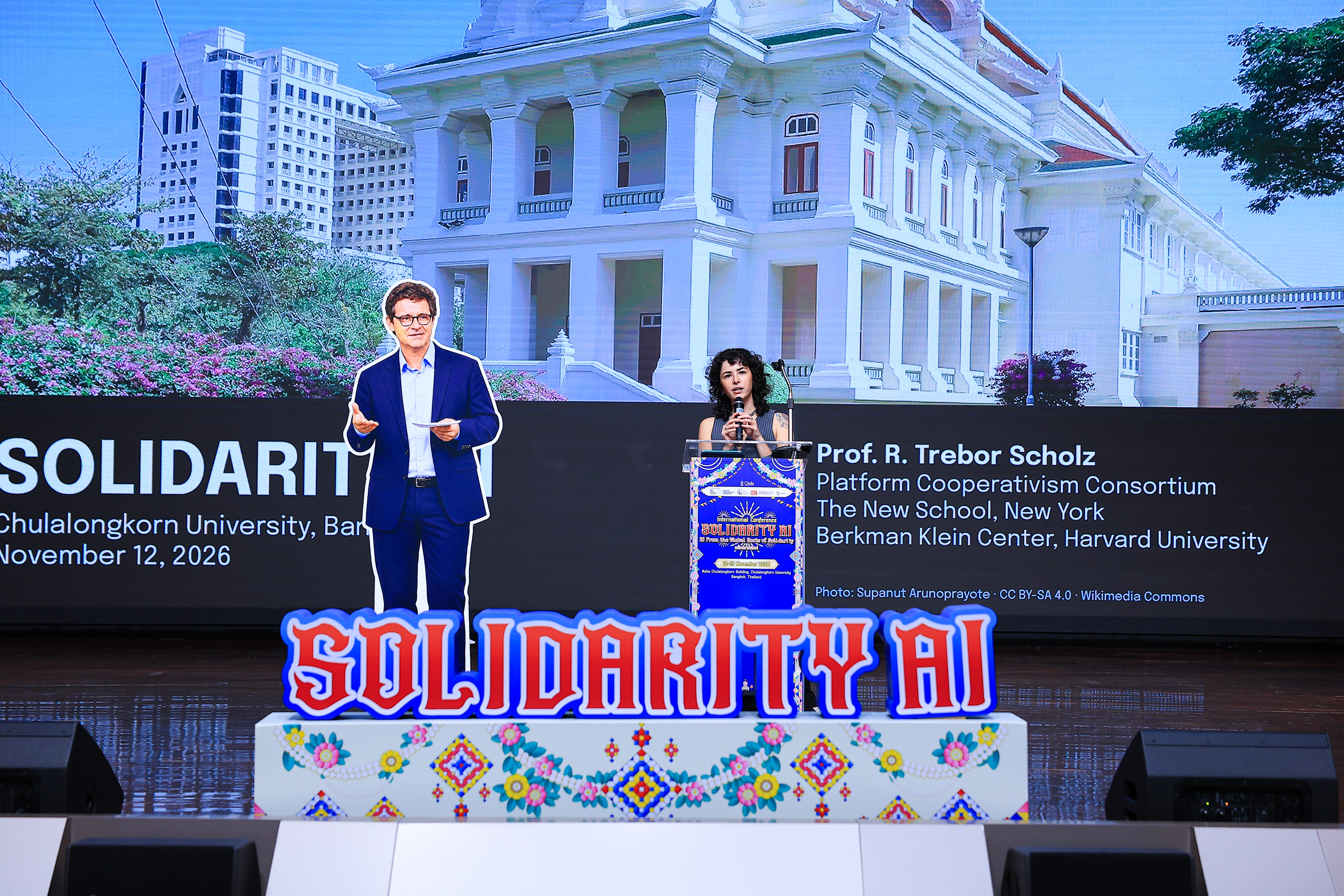
The whole conference was themed around Solidarity AI and building a “solidarity stack,” the set of tools and institutions communities would need to own and govern AI themselves. This got me excited, because it lines up really well with what we have been doing with Bread Cooperative. I feel like what we’ve been building at Bread is effectively the financial layer of that stack, a solidarity finance stack using decentralized technologies. You can find the beautifully designed program book here.
The opening talks were sober but hopeful. People were clear about the problems with AI, and the option to refuse was on the table. But few wanted to throw out the baby with the bathwater, and a lot of the conversation was about how co-ops are and could be using it.
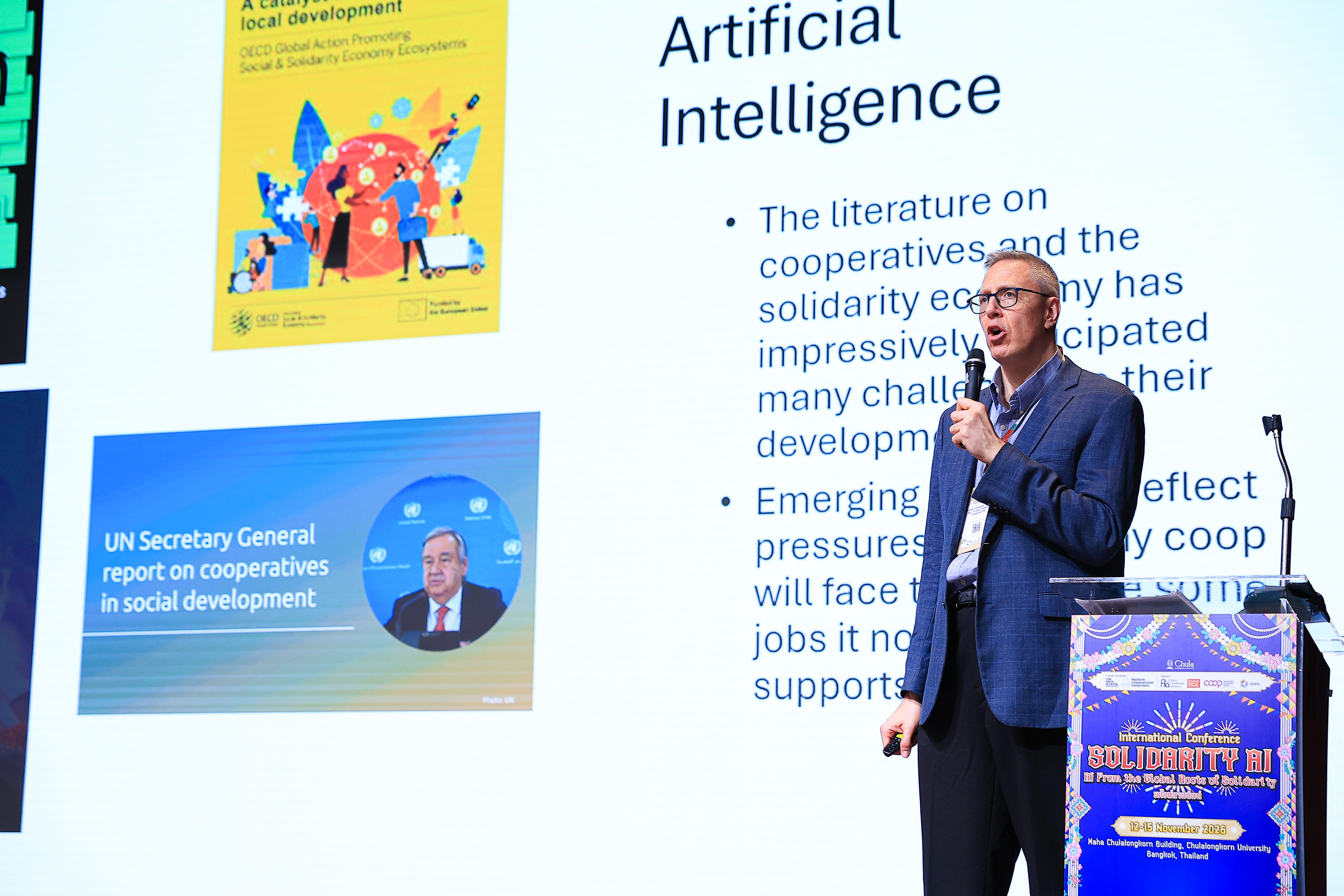
One of the first talks was from Frank Pasquale, a legal scholar who has been writing about AI and machine learning since well before its current popularity. He talked about his idea of an oppositional solidarity and made a strong case for the cooperative movement to think critically about AI and its downstream effects. The incentives around the adoption of AI could hurt worker-focused movements like cooperatives, he argued.
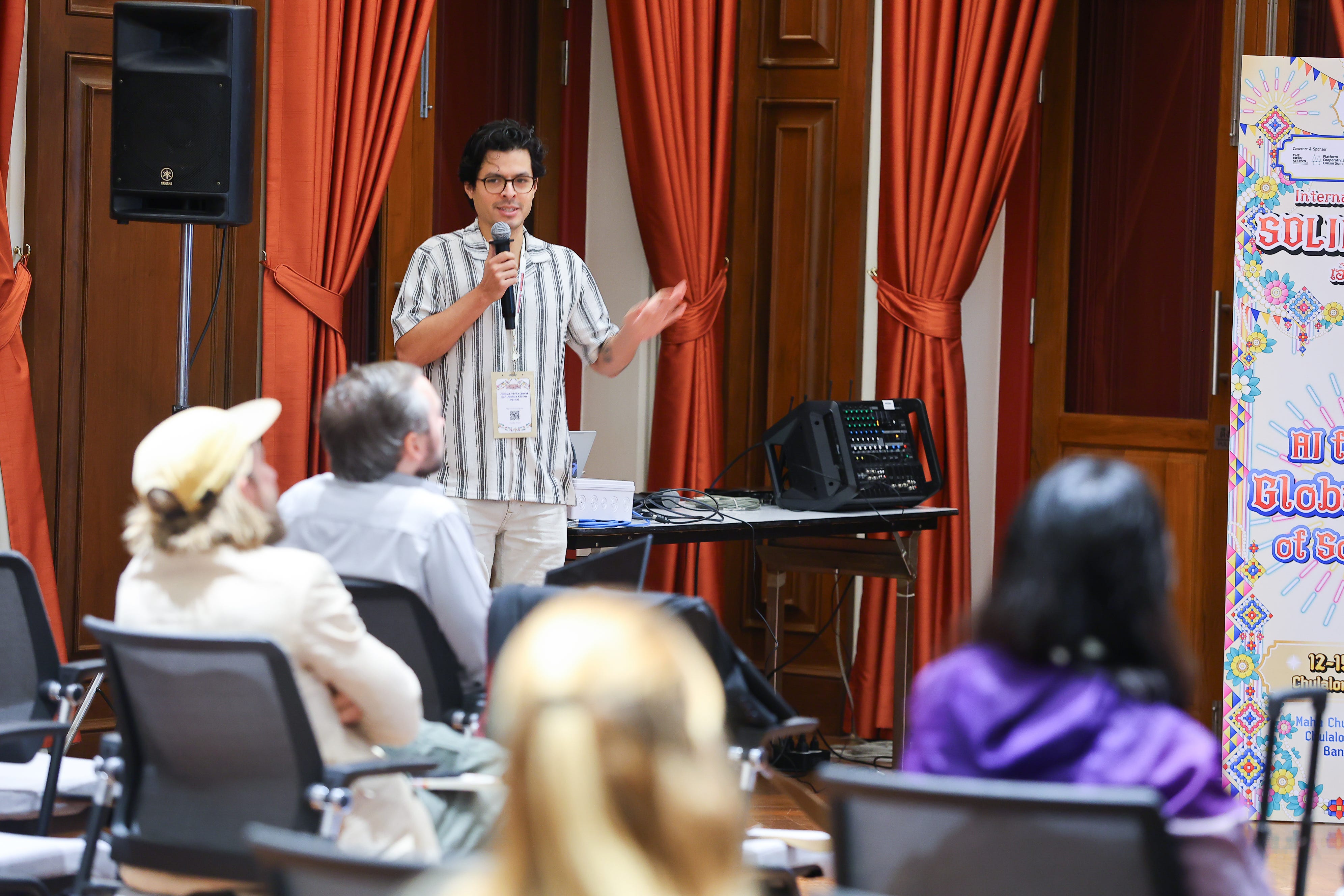
My presentation was scheduled for the first round of concurrent sessions. My talk was called “Building Cooperative Neobanking Infrastructure Based on Principles of Solidarity.” My argument is that we need to start seriously considering a cooperative neobank, and that we should build it with an internationalist mindset. There is a strong historical precedent for this in the development of credit unions in the US, which Edward Filene championed in the early 1900s. Filene ran a department store in Boston and worried about working people losing their wages to loan sharks, as well as about the coming “Age of Machines.” A philanthropist at heart, he helped pass the first US credit union law in Massachusetts in 1909 and then funded a national campaign to spread credit unions, so that workers would have financial institutions that protected them. However, today, because of regulatory capture, very few if any credit unions or cooperative banks are being created in the US and Europe as it’s become harder than ever since the Great Recession. And so I believe we need to consider avenues that are not solely down the traditional legal path, as I learned and was suggested in my interview with Brewster Kahle when he tried to start the Internet Archive Credit Union.
For better or for worse, cryptocurrency is a good technology for this, since it makes it easier to move money and build solidarity across borders. It’s not that we should all move to cryptocurrency, but that it acts as a good neutral substrate for building financial institutions. Once capital is accumulated, we could use that as leverage for getting the appropriate licenses, etc., to offer more traditional financial services in various countries. I also made the case that Bread Cooperative has already built a lot of the solidarity finance stack, and those pieces could plug into a retail-focused cooperative neobanking application.
I got a lot of really good feedback. One attendee told me it was the first time they had heard something about crypto that they fully understood and supported. That one really meant a lot!
It was also great to see my friend Max Haiven, a really interesting writer and thinker whose book Revenge Capitalism I read back in the day. He ran a workshop on his new game, Billionaires and Guillotines, which I’d played before and is very cool, so instead I went to a workshop by Kenzo Soares Seto called AI from Below: Adoption in Worker Movement Organizations.
We played a worker organization deciding whether and how to use AI, and worked through what assurances people would want. The pattern I saw was that when the AI was local and sovereign, people were much more open to using it and letting it work with the data of their activist groups.
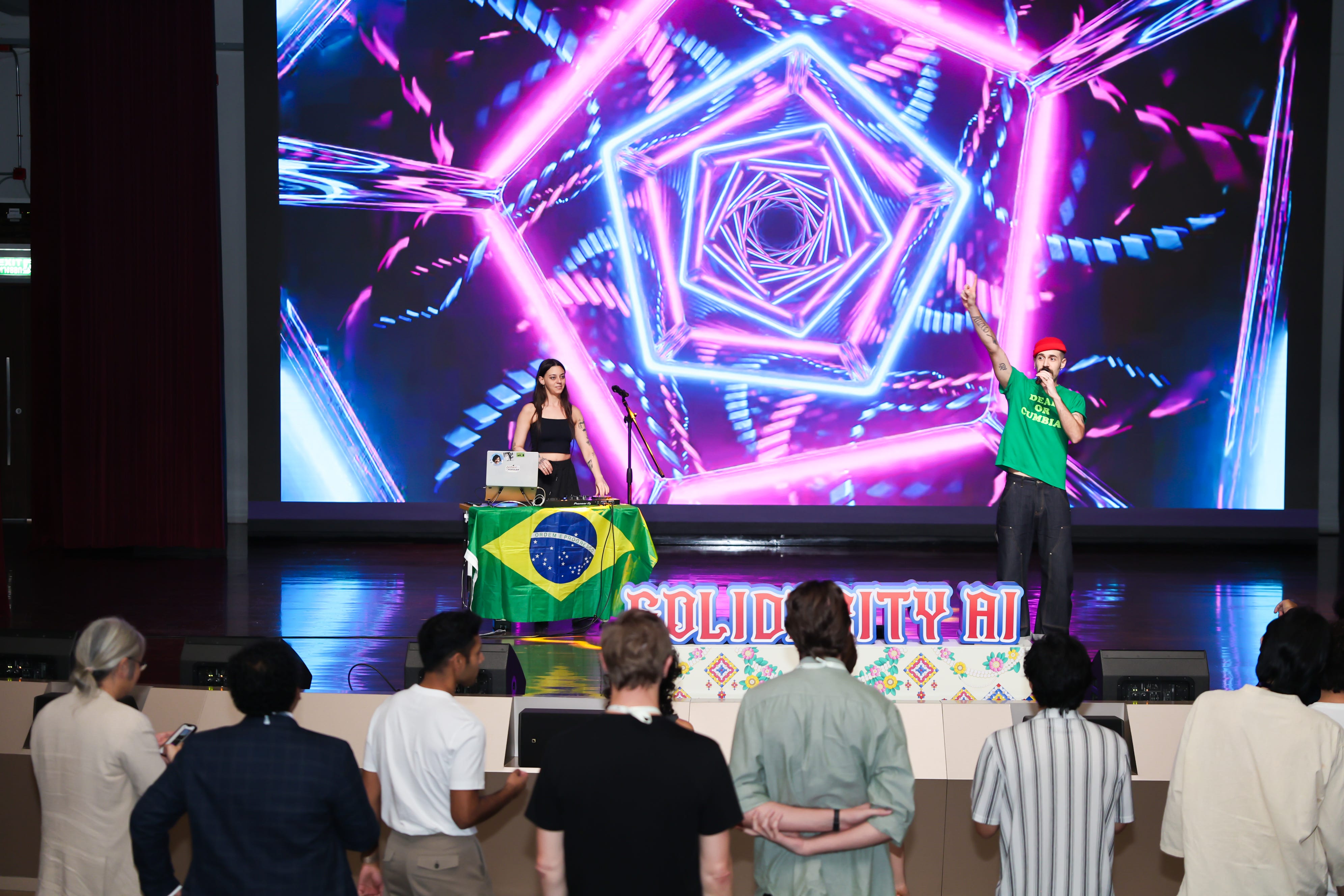
I then caught up with friends and colleagues like Morshed Mannan, who I worked with a lot on the Overthrowing the Network State series, as well as Tan Zhi Xuan, whom I had on my previous podcast as a guest to talk about her work on cooperative AI (making AI cooperative, not AI for cooperatives). Then the first day ended with a wonderful concert from Sebastián Piracés and Malfeitona with their band, Ataque Tropical. We even got the Trebor cutout to dance.
Day two and three
Day two’s highlight was a workshop from Max Haiven and Melike Kaplan, another fellow in my cohort, and it was crazy fun. They designed a game where each group represented a different world, and all the worlds were meeting at an intergalactic convention to learn from each other and figure out this AI stuff. In our world, we communicated through song, the economy ran entirely on worker cooperatives, all of our technology was grown from the ground, we were ruled by a council of grandmothers, and our main source of computing intelligence was the mycelial network of mushrooms that permeated everything.
I was our world’s representative, which meant everyone got the opportunity to listen to me sing throughout the convention. One person said I sounded like John Lennon, which has me thinking about starting a band again. Each world was also given specific goals to accomplish. Ours, for example, was to combine with another world and create an alliance to become stronger. After we began talks and introduced ourselves, there came a twist: all AI stopped working. A lot of the other worlds were completely dependent on it, and we saved the day by offering to export our mycelial technology, which was technically not AI but some kind of natural intelligence.
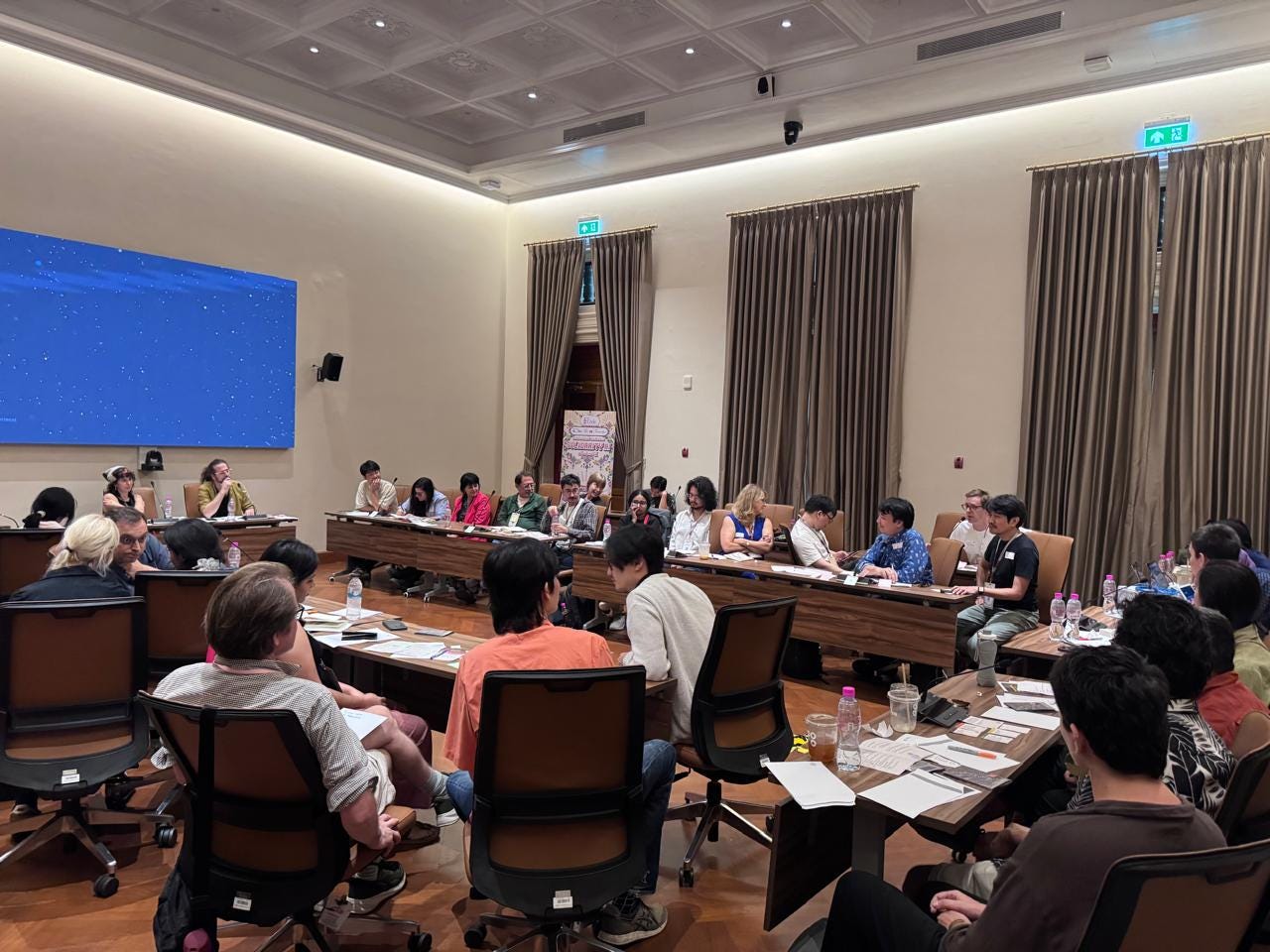
In the afternoon, Balu Iyer, Regional Director of the International Cooperative Alliance Asia and Pacific, talked about the Rochdale Pioneers who shaped the early cooperative movement and connected their story to today’s issues: technological disruption, inequality, access, democratic voice and the concentration of economic power. He was very clear that workers need to own this technology, and that the ICA is looking at how AI could be useful for its cooperatives.
On day three, I joined a workshop with my friends Ela Kagel and Andreas Arnold, along with Madelynn Martiniere, on cooperative financing and what it takes to build the financial momentum for community-owned AI infrastructure. In my group I talked about how we do things at Bread Cooperative with our Solidarity Fund, which I like to describe as a kind of community endowment with a community currency.
Mansib Rahman, another fellow and the founder of Radish Cooperative in Montreal, a cooperatively owned competitor to the big food delivery platforms, shared his experience creating the first Cooperative Agreement for Future Equity, or CAFE, which is modeled on the startup world’s SAFE. The difference is that Radish could accept investment while staying structured internally as a cooperative, and the drivers who work on the platform get a way to hold equity. If you’re in Montreal, check out Radish Cooperative.
To close the day, I went to a panel called “Building the Next Generation of Cooperatives: Are We Youth and AI Ready?” Monalisa Kashyap of the ICA moderated, with Dulce Bustamante from the Philippines, who I believe is a youth representative at the ICA, Hutri Nuryani from a technology cooperative in Indonesia, and Balu Iyer. They talked about how AI is changing the way young people see work, and what cooperatives need to do to bring them in.
One thing I learned is that in a lot of countries in Asia, cooperatives have an image problem. Young people either see them as something old people do because they’re so traditional, or as a potential scam, because the stories in the media are mostly about co-ops that failed. The movement still has to work out where it stands on AI and whether that matches what young people want, and we need a lot more young people in it. I was glad to learn there’s a youth representative on the ICA board, and it sounds like they take those concerns seriously.
Delicious Democracy
After the conference, I gave one more talk at Sam Yan Press, a pro-democracy community space above a noodle shop called Delicious Democracy Noodles. Huge shout out to Phakin Nimmannorrawong for organizing it. He's been doing his PhD on the “crypto left” at Cambridge University and invited me to speak on some of my work, especially around supporting families in Gaza.
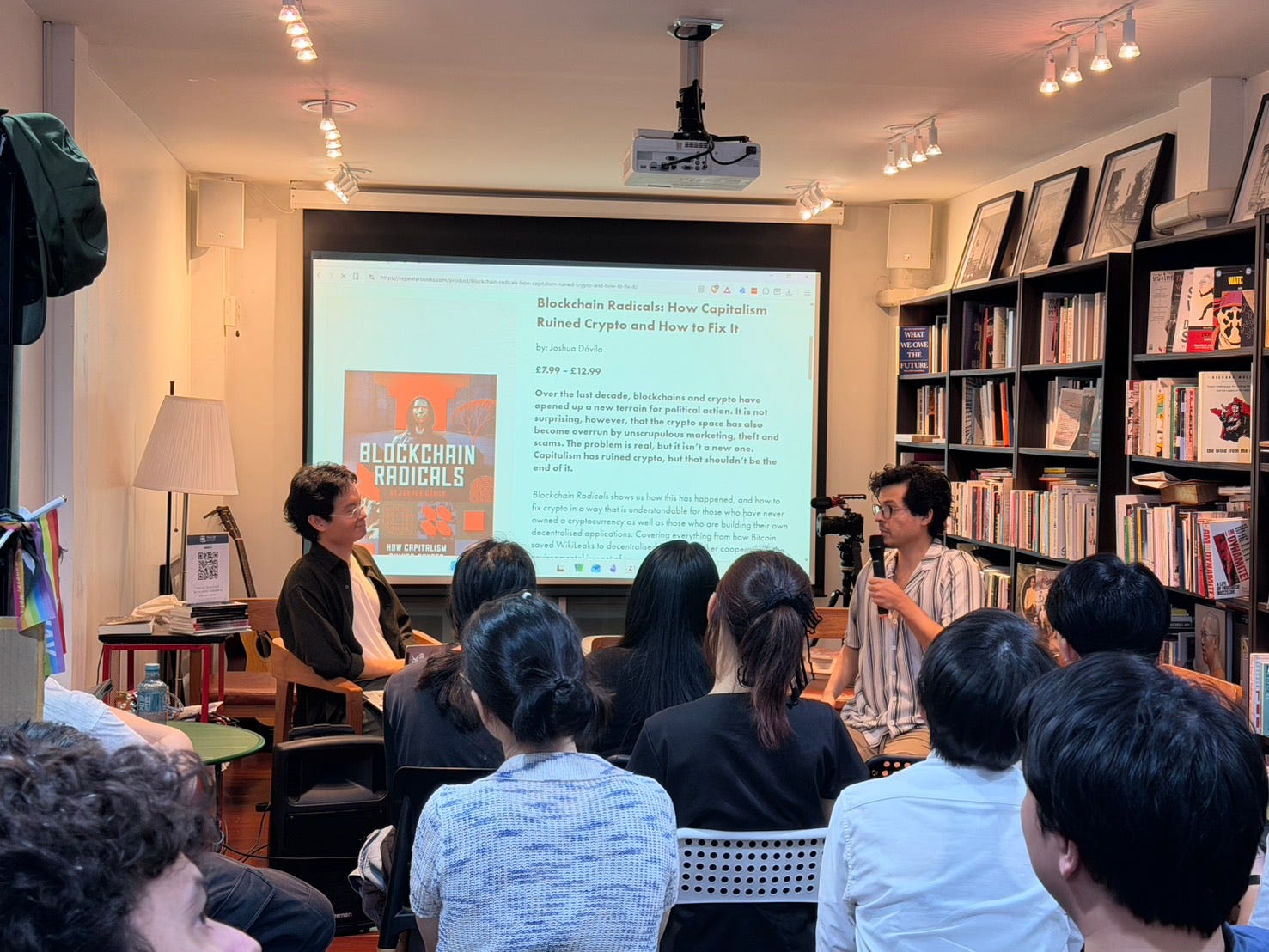
I shared my experience of helping people send crypto to Gaza, explained how blockchains and cryptocurrency work, and showed off Bread’s applications, like the Solidarity Fund. Some people from the conference came too, and the conversations afterward were great. It was also another chance to shine a light on the realities for people in Gaza and how hard it still is for them to receive money.
Overall I had a great time meeting so many people in the cooperative movement and learning about what’s happening in Asia and elsewhere. The one thing I’d like to see more of, as a way to make the solidarity stack and Solidarity AI more tangible, is sessions focused on builders or hands-on space for learning how to use AI. To get serious about the question of AI and what it means for the cooperative movement, I think we need to broadly agree upon standards, suppliers, etc., as well as what we use it for and how in a way that keeps dignity for workers and strengthens the movement (and I believe having the right financial institutions as its base is paramount).
In a world where software is no longer a moat, the platform cooperative movement has an opportunity. It’s easier than ever to compete at the functional level of existing investor-owned platforms with AI-assisted coding. In the world of software, investor-owned platforms will need to compete on market share through attention and marketing in order to create parasocial relationships towards their products and services. This is where I believe the solidarity already existing in cooperative movements is a superpower that allows cooperatives to compete with more capitalized competitors. This is my hunch at least.
I’ll be continuing my work on cooperative neobanking. If that’s interesting to you, whether you’re building something similar or are part of a co-op or credit union, please reach out. I’m also leading our fellowship call on December 3, where I’ll expand on what I presented, and I hope to publish a separate article on that soon.